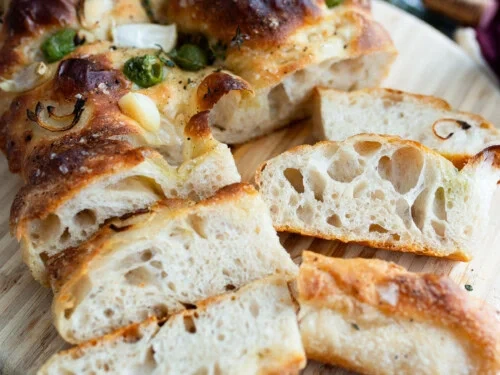
This recipe gives you a super tall and airy sourdough focaccia with a crispy and golden bottom and a tender open crumb! This recipe does come with a LOT of olive oil to give you an authentic focaccia experience, and you will also finish with a sprinkle of salt and your favorite toppings! The long fermentation provides a tangy and complex flavor, so this focaccia recipe even tastes bakery-level!
What Is Sourdough Focaccia?
Focaccia is a type of Italian flatbread, although focaccia in particular is given a very high hydration and fermentation oil ratio. This makes these a very light and bubbly focaccia recipe, so more folds and high hydration will be needed along with an active starter and a pan with plenty of oil.
Equipment You’ll Need
- A large mixing bowl
- A digital scale (very helpful)
- A 9×13 (23×33 cm) pan (metal works best)
- Parchment paper (optional)
- A bench scraper or a spatula
- A small bowl (for your brine) (optional)
Are you into brewing what you want? This is a Hot Honey Recipe!
Key Ingredients (and Why They Matter)
- Active sourdough starter (100% hydration): bubbly and at peak rise for the best lift
- Bread flour (or strong all-purpose): stronger flour helps hold the big bubbles
- Water: higher hydration = airy crumb; however, it also means sticky dough
- Salt: strengthens gluten and boosts flavor
- Olive oil: creates tenderness and the crisp, fried-like edges
- Flaky salt + rosemary (optional): classic topping combo
For this sourdough focaccia recipe, the pan oil is not optional — it’s part of the texture.
Sourdough Focaccia Recipe (9×13-inch Pan)
Yield
1 focaccia (about 12–16 pieces)
Ingredients
Dough
- 500 g bread flour (about 4 cups)
- 400 g water (about 1 2/3 cups), room temperature
- 100 g active sourdough starter (about 1/2 cup), at peak
- 10 g fine salt (about 1 3/4 tsp)
- 20 g olive oil (about 1 1/2 tbsp) — optional, but recommended
For the pan + topping
- 3–4 tbsp olive oil (for the pan)
- 1–2 tbsp olive oil (for the top)
- 1–2 tsp flaky salt
- 1–2 tbsp chopped rosemary (optional)
Optional “focaccia brine” (adds moisture + bubbles)
- 2 tbsp water
- 2 tbsp olive oil
- Pinch of salt
Step-by-Step Instructions
Step 1: Mix the dough
First, in a large mixing bowl, whisk together fully active starter and room-temp water. Then add flour, and mix until no dry flour remains. Finally, cover the bowl and let it rest for 20–30 minutes.
This step requires less effort to encourage gluten to start forming.
Step 2: Add salt (and oil)
Resuming after a break, the next step includes adding salt and olive oil which is a 20 g drizzle at your discretion. Once you fold and squeeze the dough, salt will be incorporated and the dough will be more pliable.
Step 3: Bulk ferment with folds
Allow the dough to rise at room temperature to be kept for a prescribed range of 4–6 hours to be flexibly defined by starter strength and room warmth. Within the span of the first 2 hours, a total of 3–4 sets of fold-and-stretches (30 minutes each) will be performed.
This helps the dough to become stretchy and trap air bubbles within which is vital to the success of this sourdough focaccia recipe.
Step 4: Pan the dough (same day or overnight)
Prepare your 9×13 pan with 3–4 tbsp of olive oil by coating it generously. Once the dough has been YYYYre(let it rest briefly), transfer it to the pan. Also, fold it 1 or 2 times in order to coat it.
- Same-day option: Cover and let it proof in the pan 2–4 hours until puffy.
- Overnight option (best flavor): Cover and refrigerate 12–24 hours. Then bring to room temp 2–4 hours before baking.
Step 5: Stretch, dimple, and top
When the proof goes airy and jiggles, implore of its corners. Make deep dimples and shallow presses over the surface of the pan.
This helps to bring flavor and crispness, along with salt and rosemary, which goes on top of the brine, and olive oil (1–2 tbsp) which helps to coat the surface.
Step 6: Bake
Set the oven to 450°F (232°C), let the baking party begin!
Bake for 20-25 minutes until the top is golden brown and the edges are crisp. Leave it to cool for 10-15 minutes before cutting it. It allows the crumb to set.
Your sourdough focaccia recipe is going to bubble and have a crispy bottom with a soft center.
Baking Schedule
- Morning mix + same-day bake: ~7–10 hours total
- Overnight cold proof: mix day 1, bake day 2
Pick whichever schedule you prefer. Don’t feel the need to rush the dough.
Topping Ideas
After you get the hang of this sourdough focaccia recipe, the topping options are endless.
1) Cherry tomato + garlic
This recipe involves garlic and tomatoes. Don’t include too much of either. That can make soggy centers.
2) Olive + oregano
Dimples are for olives, top with oregano and oil and a salt sprinkle.
3) Parmesan + black pepper
For this one, add Parmesan.
4) Spicy honey finish
After rosemary and salt, add hot honey for a touch of sweetness.
How To: Crisp Bottom (Key Tips)
- Metal pan is preferred over a glass pan.
- Make sure to oil the pan well to form the desired crust.
- Don’t bake until a “light tan, boil only until the top is deep golden.”.
- Last option, let it sit for the final 5 minutes of baking on the bottom rack.
Make-Ahead and Storage
- Room temperature: Wrap well and keep up to 2 days.
- Fridge: Not ideal (it dries bread), but it’s okay short-term; reheat to revive.
- Freezer: Slice, wrap, and freeze up to 2 months.
Store-bought sourdough lasts as long as homemade bread. To reheat it, warm at 375°F (190°C) for 8–12 minutes. The bread recovers its wonderful sourdough texture.
Troubleshooting
It didn’t rise / it’s dense
The starter not being active enough is most likely the reason. Use starter at its peak, and bulk ferment until the dough markedly lightens.
It spread but didn’t get bubbly
It may be under-proofed in the pan. Next time, let it get jigglish and puffy before dimpling; otherwise, bubbles won’t develop in your sourdough focaccia recipe.
It stuck to the pan
Not enough oil, or the pan wasn’t well-coated. Additionally, using parchment under the dough may help if your pan is prone to sticking.
The top brown but the center feels gummy
It likely needed more bake time. Do not cut down the bake time, and add more time to cool.
Frequently Asked Questions
Can I use all-purpose flour?
Yes, but bread flour provides a better structure and stronger rise due to the higher protein content.
Can I lower the hydration if I’m new to sticky dough?
Yes – you can start with 375 g water compared to 400 g. Afterwards, you can always increase with confidence for an opening and airy crumb.
Can I include sourdough discard?
Sourdough discard lacks the ability to reliably raise the dough. For this reason, this sourdough focaccia recipe is most effective with an active starter. You may add a small amount of discard to the recipe, however, don’t rely on it for the dough to rise.
Conclusion
If you are wondering how to get an easy and effective sourdough focaccia recipe for bakery-quality focaccia, you’ve come to the right place! This method involves mixing the dough, folding the dough, and then dimpling and baking until focaccia is a gorgeous golden brown. One you’ve practiced a few times, achieving the perfect focaccia can quickly turn into an effortless feat. With the right timing, you can experiment with a dozen different focaccia toppings to get a consistently delicious focaccia every single time!