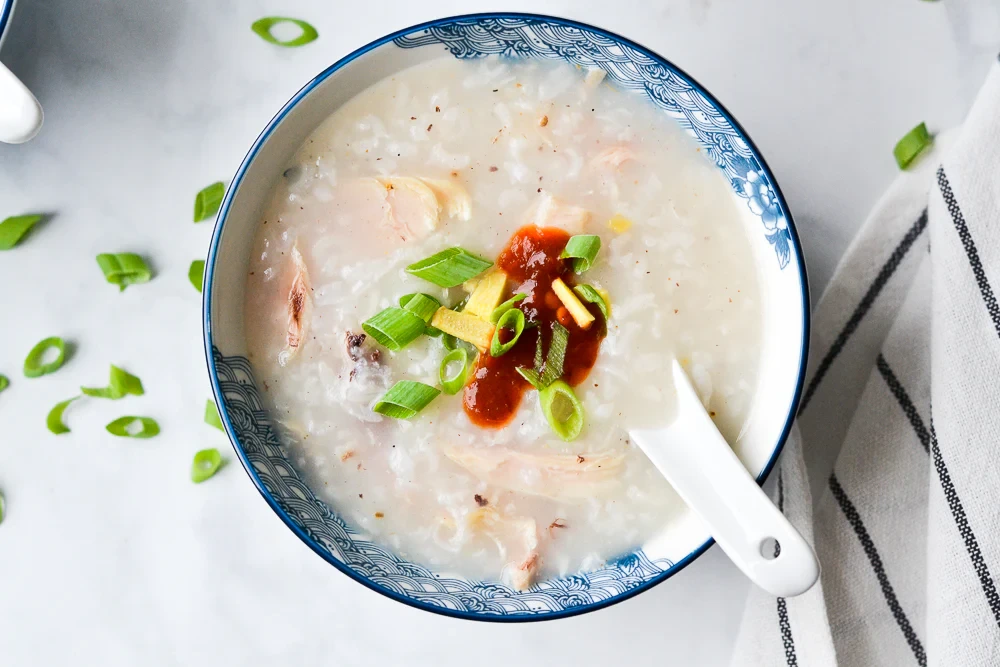
This rice porridge recipe is slow-simmered, creamy rice cooked with water or broth until they are soft and silky. It’s gentle on the stomach, budget-friendly, and can be made however you like, sweet or savory, with chicken and ginger or with cinnamon and milk. Learn the rice-to-liquid ratios to control thickness as well as avoiding bland, gummy, and scorched porridge.
What Is Rice Porridge?
Rice porridge is rice and liquid cooked until it is broken down into a thick, spoonable mass. It can go by different names depending on where you are, such as:
- Congee (savory, with a style from China)
- Juk (from Korea, smooth and mild)
- Arroz caldo (ginger in a hearty style from the Philippines)
- Rice pudding-style porridge (made with milk and sugar)
In any case of porridge you make, the main idea is to have a creamy and soft rice grain that takes a bit of time to break down.
Why You’ll Love This Recipe
- Even with the simplicity of the ingredients, it is comforting and hearty.
- Eat it at any time of the day; breakfast, lunch, or dinner.
- Easy to make larger batches for meal prep and leftovers taste great after a quick warmup and adding a bit of liquid.
- Sweet or savory, you can have whatever you like!
Equipment You’ll Need
- Medium or large saucepan (heavy-bottomed helps prevent burning)
- Spoon or silicone spatula (stirring is important)
- Measuring cups
- Optional: ladle, fine mesh strainer (if rinsing rice)
Related Recipe
If you want something else that’s very comforting that you can make in no time, you might enjoy this Pastina Recipe.
Key Ingredients
1) Rice (base)
- Jasmine rice: slightly sticky and fragrant (good for basic recipes) (refers to basic porridge)
- Short-grain rice: thicker, velvety porridge
- Long-grain rice: less creamy, lighter, velvety, with longer cooking time
- Brown rice: can work, but takes extra time and liquid
If you’re running lower on time and have leftover rice, you can make porridge; however, the texture does differ (as you will discover below).
2) Liquid (influences texture and flavor)
- Water: convenient base
- Chicken broth or veggie broth: helps to add that savory depth
- Milk (or plant milk): if you want a sweet breakfast porridge, this is the one to pick
Looking to create a porridge breakfast bowl? Or maybe to create a recent comfort food creation? Pick your liquid accordingly.
3) Salt (small but important)
Even sweet versions need a pinch of salt; otherwise, the flavor tastes flat.
4) Aromatics (optional but recommended for savory)
- Ginger: bright
- Garlic + onion: complex, deep base (use minimally as needed)
- Scallions: fresh.
5) Toppings (complete)
Savory toppings: shredded chicken, soft-boiled egg, chili crisp, sesame oil, soy sauce, herbs
Sweet toppings: cinnamon, honey, fruit, toasted nuts, jam
Rice Porridge Recipe (Basic Stovetop Method)
This is the foundational recipe for rice porridge that you can build on in either direction.
Yield
4 bowls (or 6 small bowls)
Ingredients
- 1 cup uncooked rice (jasmine or short grain preferred)
- 7 or 8 cups water or broth (start with 7, add as necessary)
- 1 tsp salt (adjust for salted broth)
Optional savory add-ins (gentle and classic)
- 1-2 inches fresh ginger, sliced (or 1/2 tsp ground ginger)
- 1 garlic clove, smashed (optional)
- 2 scallions, chopped (for serving)
Step-by-step Instructions (Stovetop)
First Step 1: Rinse the rice (optional but helpful)
- First rinse the rice quickly under cold water. Then drain well.
- This removes the excess surface starch, but for very creamy porridge you can skip the rinsing and just cook a bit longer.
Step 2: Start the Simmer
- Add the rinsed rice and 7 cups of liquid to a pot. If including ginger (and optional smashed garlic), add that as well.
- Bring to a halt and and then reduce to maintain an even simmer.
Step 3: Simmer low and slow
- Next, simmer on low heat without a lid for 35–50 minutes, and stir every 5–10 minutes for the first 10 minutes.
- As the rice softens, stickiness becomes a problem so stir often.
Final Step: Adjust thickness
After 30 minutes, test to see if the consistency is how you like it.
- If it’s too thick, add 1/2 cup of hot water/broth, stir and serve.
- If it’s too thin, leave it to simmer for longer until you see the desired consistency.
This way you can leave it to be thick and require a spoon, or have a consistency like a soup.
Step 5: Season and finish
- Ginger slices are easily removable, so do this and season to taste with salt.
- Now that the base is done, as savory or sweet, leave them to head in the direction you prefer.
- This is actually the base for a rice porridge recipe, so you can customize it as you like.
Two Ways to Flavor It: Savory or Sweet
Option A: Savory Ginger Chicken Rice Porridge (Simple and Comforting)
Add these ingredients (for 4 bowls)
- 2 cups cooked shredded chicken (especially great with rotisserie)
- 1–2 tbsp soy sauce (or tamari)
- 1 tsp toasted sesame oil
- Black pepper to taste
How to finish
- Stir in the chicken so it warms up, and then add the soy sauce and sesame oil, and, finish with some scallions on the top of each bowl.
- You can also make it your own with a soft boiled egg or go for chili crisp, If you want it a little richer.
Option B: Sweet Breakfast Rice Porridge (Creamy and Cozy)
Add these ingredients (for 4 bowls)
- 2 cups milk (or oat/almond milk) added near the end
- 1–3 tbsp honey or maple syrup (to taste)
- 1 tsp vanilla extract
- 1/2 tsp cinnamon
- Pinch of salt
How to finish
- When porridge is nearly done, stir in milk and simmer for 5–10 minutes. Then sweeten and add vanilla and cinnamon.
- Finally, top with fruit, nuts, or jam.
- This sweet variation keeps the same base, so your rice porridge recipe stays easy even when switching flavors.
Ratio Guide (So You Can Scale or Change Texture)
A helpful starting ratio for uncooked rice is:
- 1 part rice : 7 parts liquid for thick porridge
- 1 part rice : 8–9 parts liquid for soupier porridge
However, rice types vary; therefore, always plan to add extra hot water/broth near the end to dial in your preferred consistency.
Comparison Section: Rice Porridge vs Congee vs Oatmeal
Rice porridge vs congee
- Congee is essentially a type of rice porridge, often cooked longer and sometimes thinner, with strong savory toppings.
- A general rice porridge recipe can be savory or sweet and may be cooked to a thicker, creamier finish.
Therefore, if you want a classic savory bowl with toppings, treat this as congee-style and keep it slightly looser.
Rice porridge vs oatmeal
- Oatmeal has a creamy starch, and cooks faster.
- Rice porridge takes longer to cook, but it is gentler and can be made smoother. Plus, it is better for someone who likes neutral flavors.
White rice vs brown rice porridge
- White rice can be made creamy quicker.
- Brown rice can be more of a nutty flavor. However, it takes longer to cook and needs more liquid.
Methods Comparison: Stovetop vs Instant Pot vs Slow Cooker
Stovetop (most control)
- Good for real time thickness adjustments.
- Stirrings required towards the end though it is very reliable.
Instant Pot (hands-off)
- Great for very little workflow and consistent results.
- Needs some adjusting of the liquid to not get a “Burn!” warning.
Slow cooker (set-and-forget)
- Probably best for overnight or workday cooking.
- Can get very thick so needs some adjusting of liquid usually towards the end.
Instant Pot Rice Porridge (Fast, No Babysitting)
Ingredients
- 1 cup rice
- 8 cups water or broth
- 1 tsp salt
- Optional ginger slices
Instant Pot Steps
- First rinse the rice (this step is optional) and add everything to the pot.
- Next cook on High pressure for 25 minutes.
- Then allow 10 minutes for the natural pressure to release and then do a quick release.
- Finally stir well and add hot water or broth for extra thinness.
Pressure cooking rice breaks the grains down quicker so this makes an extra creamy bowl, making it perfect for a weeknight rice porridge recipe.
Slow Cooker Rice Porridge (Great for Mornings)
Ingredients
- 1 cup rice
- 9 cups water or broth
- 1 tsp salt
- Optional ginger
Slow Cooker Steps
- Add everything to the slow cooker.
- Cook on LOW 6-7 hours or HIGH 3-4 hours.
- Stir the porridge and add extra liquid if needed.
If your slow cooker isn’t loud and aggressive, you can just let it go without stirring. Otherwise, stir it once or twice during cooking.
Using Leftover Cooked Rice (10-Minute Shortcut)
This alternative requires only 3 cups of cooked rice and 4-5 cups of water or broth, starting with the smaller amount.
Steps
- Stick your rice and liquid in a pot and let them simmer for 8-12 minutes.
- Mash the rice a little until it’s mostly broken up.
- Season to your taste.
While it won’t be quite the same, this shortcut gives you a very satisfying rice porridge with very little effort.
Expert Tips (How to Make It Taste and Feel Better)
1) Use hot liquid for adjustments.
Cold water or broth slows the cooking process of the rice, so the porridge takes longer to thicken.
2) Stir more as it thickens.
The rice will stick to the bottom of your pot more as the starch thickens, so stir more frequently and it’ll subside.
3) Season in layers for savory versions.
You can add a little salt early so you can finish with soy sauce or sesame oil, without oversalting.
4) Finish with brightness.
Adding lime, scallions, and herbs enhances the flavor profile and helps cut the richness of the toppings.
5) Don’t fear too thin.
Rice porridge will naturally thicken over time. To mitigate this, make your porridge thinner than you’d typically prefer.
6) For a smooth texture, whisk or blend briefly.
For a “juk-like” texture, blend with an immersion blender for 5–10 seconds, being careful not to blend too long or your porridge will have a glue-like texture.
Best Savory Toppings (Build a Perfect Bowl)
Combining toppings with different textures or temperatures is a great way to liven up your porridge:
- Soft-boiled eggs or fried eggs
- Shredded chicken or pulled pork
- Sautéed mushrooms
- Sautéed mushrooms
- Chili crisp or chili oil
- Soy sauce, tamari, or coconut aminos
- Toasted sesame oil (a few drops)
- Scallions, cilantro, or parsley
- Toasted sesame seeds
Want to cut the richness of the porridge? Use Pickled Red Onion Recipe for extra brightness.
Best Sweet Toppings (Breakfast-Friendly)
- Cinnamon + honey
- Banana and peanut butter
- Berries and yogurt
- Toasted coconut and mango
- Raisins and chopped nuts
- Jam swirl
Adding a small pinch of salt keeps it from being a one-note sweet option.
Make-Ahead, Storage, and Reheating
Storage
Keep porridge in an airtight container and refrigerate for 4 days or freeze for 2 months (For best results, freeze a plain base and add toppings after reheating).
Reheating
- Add 2–4 tbsp of water or broth to each bowl (or more if very thick).
- You may use a microwave or stove top.
- Creamy texture can be achieved by stirring it.
Porridge in the fridge will have a gelatinous texture. Adding liquid to the porridge saves the overall consistency of the porridge.
Common Problems + Fixes
It burned on the bottom.
Using a heavy bottom pot on a lower heat setting helps burn less. Simmer and stir more often.
It tastes bland.
Add salt first. Finally, add a finishing ingredient. Soy sauce, sesame oil, and ginger are all good options. Finally, toppings add flavor fast, so don’t skip them.
It’s too thick.
Add hot water or broth in small amounts to keep the flavor.
It’s too thin.
Cook it for a longer time with the lid off. Another way is to stir more often so that some water evaporates.
The texture feels gluey.
A gluey texture is over blended porridge especially with short-grain and high-starch rice.
8 Frequently Asked Questions
1) Is rice porridge the same as congee?
They are the same when made in the style of a savory rice porridge called congee, but rice porridge can also be sweet.
2) What’s the best rice for this?
Jasmine and short-grain rice tend to produce a creamier porridge. Long-grain rice also makes a creamier porridge, when compared to short and long-grain rice.
3) Do I have to rinse the rice?
The porridge is creamier more quickly when the rice is not rinsed. You gain a less creamy porridge that is less sticky when you rinse the rice.
4) Can I make this recipe vegetarian?
Absolutely! It can be made vegetarian by substituting vegetable broth or water. You can add mushrooms and tofu, and if you eat eggs, a jammy egg is a great alternative.
5) Can I make it dairy-free?
Definitely. For ‘savoury’ bowls use broth or water, and for ‘sweet’ bowls use oat or almond milk. Make sure you add plant milk towards the end of the cooking process to avoid scorching.
6) How do I make it more filling?
In order to fortify the dish, add protein and fat: shredded chicken, tofu, egg or drizzle of sesame oil. Also, add more veggies to make the dish a little more hearty and filling.
7) Can I freeze rice porridge?
You can freeze rice porridge. In fact, the plain base is perfect for freezing. It can look separated upon thawing, but you can add more liquid and reheat it to restore the ‘creaminess’.
8) Why does it get thicker overnight?
Rice can absorb a lot of liquid. You can restore the original texture by adding water or broth and reheating it.
Conclusion
This ‘rice porridge recipe’ is a simple and easy recipe that you can enjoy at any time even if you want to switch it up from a sweet ‘breakfast porridge’ to a ‘savoury ginger chicken bowl’ as the core technique of this recipe doesn’t change.